States of Consciousness
Book available on archive.org.
I would NOT recommend this book wholesale. CH6 and CH7 are sorta interesting from an inspiration and perspective angle, CH2 has a cool table of cool subjective experiences you can have, but there’s a lot of garbo in the book as a whole.
Some terminology:
- SoC - state of consciousness
- d-SoC - discrete state of consciousness (it seems to stick together as its own thing)
- d-ASC - discrete altered state of consciousness (we knocked someone out of baseline and it stabilized long enough to be relevant)
- * Mostly for the perspective of this book. Sociocognitive academics would hate these terms because they’re far too loose, and I tend to agree, but Tart’s got advice on creating trance-like experiences, and most sociocognitive authors focus on explaining it away.
I like this guy’s takes on how wild trance can feel but a lot of this made me feel like I was a side character in True Facts About The Dung Beetle.
Ch2 - The Components of Consciousness: Awareness, Energy, Structures
Section titled “Ch2 - The Components of Consciousness: Awareness, Energy, Structures”Table 2-1 - Experiential Criteria for Detecting an Altered State of Consciousness
- Exteroception (sensing the external world)
- Alteration in various sensory characteristics of the perceived world - glowing lights at the edges of things, attenuation or accentuation of visual depth
- Interoception (sensing the body)
- Alteration in perceived body image - shape or size changes
- Alteration in detectable physiological parameters - accelerated or retarded heart rate, respiration rate, muscle tonus, tremor
- Perception of special bodily feelings not normally present - feelings of energy in the body, generally or specially localized, as in the spine, change in the quality of energy flow in the body, such as intensity, focus vs diffuseness
- Input-Processing (seeing meaningful stimuli)
- Sensory excitement, involvement, sensuality
- Enhanced or decreased sensory intensity
- Alterations of dominance-interaction hierarchies of various sensory modalities
- Illusion, hallucination, perception of patterns and things otherwise known to be unlikely to actually exist in the environment
- Emotions
- Alteration in emotional response to stimuli - overreacting, under-reacting, not reacting, reacting in an entirely different way
- Extreme intensity of emotions
- Memory
- Changes in continuity over time - either an implicit feeling that continuity is present or an explicit checking of memory that shows current experience to be consistent with continuous memories leading up to the present, with gaps suggesting an altered state
- Details. Checking fine details of perceived environment (external or internal) against memories of how they should be to detect incongruities
- Time Sense
- Unusual feeling of here-and-nowness
- Feeling of great slowing or speeding of time
- Feeling of orientation to past and/or future, regardless of relation to the present
- Feeling of archetypal quality of time; atemporal experience
- Sense of Identity
- Sense of unusual identity, role
- Alienation, detachment, perspective on usual identity or identities
- Evaluation and Cognitive Processing
- Alteration in rate of thought
- Alteration in quality of thought - sharpness, clarity
- Alteration in rules of logic (compared with memory of usual rules)
- Motor Output
- Alteration in amount of quality of self control
- Change in the active body image, the way the body feels when in motion, the proprioceptive feedback signals that guide actions
- Restlessness, tremor, partial paralysis
- Interaction with the Environment
- Performance of unusual or impossible behaviors - incongruity of consequences resulting from behavioral outputs, either immediate or longer term
- Change in anticipation of consequences of specific behaviors - either prebehavioral or learned from observation of consequences
- Change in quality of voice
- Change in feeling of degree of orientation or to contact with immediate environment
- Change in involvement vs. detachment from environment
- Change in communications with others - incongruities or altered patterns, consensual validation or lack of it
- (This category represents combined functioning of several subsystems)
A continuum of awareness of focus vs self awareness. Vipassana tries to deliberately create self awareness. A car wreck or focusing on an ex can both pull your attention in different directions.
Types of species of ‘structures.’ Permanent - biological/physiological mechanisms. Programmable - conditioning. The permanent limits the programmable. Tart’s interested in ‘relatively permanent’ (but modifiable) structures.
You can create structures. EG - learning times tables sucked - but now it’s relatively automatic. Attempts to stop a structure from behaving in a previous way may fail. Shifting heavily ingrained structures may be impossible or impractical. They suggest focus/awareness is a possible structure.
Some structures might override other structures. EG - if you’re in severe pain during a medical procedure, being told ‘just relax’ may be actually impossible.
Structures can interact as well, or combine to become one.
Ch5 - Discrete States of Consciousness
Section titled “Ch5 - Discrete States of Consciousness”I’ve got a lot of disagreements here. Let me see what interesting bits I can scrape up though…
- They define a d-SoC as a configuration of subsystems. The parts change, but you can recognize it. They explain the components must be understood together - much like you couldn’t understand what a car did if the parts were laid out all over the ground.
- The ‘gestalt’ pattern of recognition is - “wow, this feels wildly different!” But you can map it onto parameters.
- I’m not… interested enough on that paper on ego states to go dig it up.
Ch6 - Stabilization of a State of Consciousness
Section titled “Ch6 - Stabilization of a State of Consciousness”- The point of a d-Soc is to support existing within an environment.
- It’s dogmatic - but they suggest stabilizing a d-SoC mirrors how people control each other.
- 1 - You keep them busy with activities that are part of being a good part of the community.
- 2 - Reward them
- 3 - Punish them
- 4 - Limit chances to engage with anything that would let them out of the loop.
Loading Stabilization
- The system will not be disrupted if someone keeps busy with things behaving as expected.
- EG - if you pushed your hand through your desk unexpectedly, like a ghost, you might suspect your standard d-SoC broke.
- EG - if you felt half your body disappear, this would break it.
- EG - if your arm suddenly felt much heavier than expected, this would break you out of it. If you wanted to avoid sleeping (another d-SoC,) moving around and staying active would help you stay out of that one.
- EG - constant thinking maintains a d-SoC. (They mention this is the biggest one.)
Negative Feedback Stabilization
- When subsystems go beyond their limits. EG - feeling anxious about taboo thoughts - you self-correct and stop thinking about them.
- Maybe you were lost in thought - and something brought you back to attention. It possibly happened out of awareness, but something knocked your system back into gear.
Positive Feedback Stabilization
- Rewards!
- You drive way too tired and almost wreck. Next time - you feel anxious about driving and very alert.
- Positive and negative feedback don’t really mean good or bad. Negative feedback happens when something goes out of limits, positive feedback starts a reward process for staying within acceptable limits.
- (This section feels a tad weak… Could’ve just called it reinforcement? But this is all theoretical in the sense of theory crafting and being so poorly defined it’s untestable. It may still be useful food for thought for getting a cool zonk though.)
Limiting Stabilization
- Limits what’s possible in certain subsystems.
- EG - tranquilizers - they blunt emotional responses. You can’t get knocked into another ‘state’ when you are forced to stay emotionless. (?)
- Limiting directly affects subsystems, where loading indirectly guides them.
Ch7 - Induction of Altered States: Going to Sleep, Hypnosis, Meditation
Section titled “Ch7 - Induction of Altered States: Going to Sleep, Hypnosis, Meditation”A d-SoC stabilizes because of its environment. So - in order to create a d-ASC, create an environment where the d-SoC is not required, and then you need to figure out how to build the d-ASC.
Inducing a d-ASC: General Principles
Usually - you’ll start with ‘normal’ (in Tart’s words, ‘consensus’) consciousness. They’ll call this baseline - or b-SoC. The b-SoC is reinforced by all the shit from the previous chapter - loading, negative, positive, and limiting stabilization. So - the deck is usually stacked against the person looking for a d-ASC.
The process is what happens internally; the operations are the particular things you do to yourself, or someone does to you, to make the induction process happen.
Tart, C. T. (2000). States of Consciousness. iUniverse.com, Inc. (Original work published 1983, Dutton)
Induction Operations: Disruption and Patterning
The first part of disrupting a d-AsC…
- You’re going to need to disrupt multiple loading systems. You can clap your hands loudly at someone, and they’d get ‘knocked out of it,’ but since there are multiple systems bringing someone back to the b-SoC, it wouldn’t do much.
- You need to disrupt it hard enough that the d-AsC can’t hold its integrity.
- You can disrupt stabilization by either directly identifying them, or pushing them beyond their limits to where they can no longer work.
- EG - some systems can be disrupted by overloading them with stimuli, removing stimuli, or providing stimuli that can’t be processed in normal, habitual ways. A gentle way to do it is by drawing attention away from the system. The hope is that doing this will have an effect on secondary system.
- Drugs, exhaustion, or exercise can disrupt a b-SoC.
And the second part…
- “Apply patterning forces.” Give stimuli that doesn’t make sense to the b-SoC. EG - show them a diagram that makes no freaking sense (which is a mild disruption.) However, since it may be processed by a d-ASC more easily, it’ll encourage that. (EG - meditation mandalas.)
Steps in the Induction Process
- The b-SoC starts out as a set of set of mental patterns / structures. There are patterns / structures currently unavailable to the b-SoC.
- To start the induction - you apply patterning and disruptive forces to the stable structure of structures. You’re trying to ‘loosen’ things up. Some of the subsystems will reach their limits, and the way the structures fit into each-other will start to break down.
- Some of the systems, not yet available to the b-SoC may reshape themselves.
- If the disrupting forces are successful in breaking down the b-SoC, it kicks off a transitional period. Psychological structures stop reinforcing each other. In addition - the disrupting forces become less important, and the patterning forces more so. These patterning forces push the structures into a new form, along with other structures previously unavailable to the b-SoC.
- The d-ASC forms, stabilizing. Patterning and disruptive forces are a bit less important now, as the system seems to be able to hold its own. Patterns previously unavailable are likely integrated into the d-ASC.
- To get into this d-ASC the first time, you might need a lot of supportive disrupting and patterning forces. However, in the future, it may be easier to get there. (EG - the first time you zonk someone, you might need a chill, safe, space, with very low environmental demands. In the future - it could be much easier for someone to do this in a noisy, busy room.)
- The ‘deinduction’ is usually less of a concern, as it often happens naturally. EG - normal patterning and disruptive forces come back, pushing back in the direction of your b-SoC, it’s a familiar pattern, and you’ll likely snap back to it.
Going to Sleep
- This one’s pretty intuitive. When you want to sleep - you shut out distractions, dim the lights, and get comfy. They suggest that removes loading stabilization for your ‘awake state.’
- Huh - according to Tart, when you’re staying relaxed and still for long periods, there is no change in your kinesthetic receptors, so they stop sending messages to your central nervous system.
- You think (if you’re good at sleeping) that there’s nothing important to do but rest and relax.
Your attitude is there is no normative pattern to your consciousness.
Tart, C. T. (2000). States of Consciousness. iUniverse.com, Inc. (Original work published 1983, Dutton)
- TRYING to sleep usually isn’t helpful. That usually helps in your d-SoC with getting things done, but it you’ll do better by just watching sleep happen.
- They highlight that the attitudes of nothing being important and inaction are similar to inducing other d-ASCs. Tiredness acts as a ‘disrupting’ force. If the tiredness is not there, you don’t have the nudge to pass out and adopt this mindset.
- They say, citing Vogel in Ch5 of this book, that there were two (to three) distinct experiences when starting to sleep. Feeling contact with the environment (intact ego state) => losing contact with the environment and becoming a pile of thoughts (destructuralized ego state.)
Inducing Hypnosis
-
- Inductions vary. They usually have you sit comfortably and as still as reasonable. They suggest this allows you to ameliorate anxiety, as well as (similar to sleep) letting your kinesthetic system adapt out.
-
- In addition, they ask you to listen to their voice and ignore other thoughts/sensations. This attenuates the load of ‘cognitive busyness.’
-
- Inductions often suggest you listen passively. This limits (often counterproductive) critical evaluation. While reducing critical evaluation is good, this also reduces the loading stabilization of evaluation.
-
- Inductions (usually) ask you to bring your attention back to a focus. This not only prevents you from looking around (and getting distracted,) but you usually don’t stare at just one thing. You may attribute vision changes (EG - the Troxler effect) to the hypnotist, or some sort of change that is not normally seen. This may contribute to the input-processing subsystem being forced to handle something out of the ordinary. The hypnotist suggested earlier you may have an unusual experience, and this unusual experience serves as evidence either in the hypnotist’s skill or something funky is going on.
-
- Ah - a classic, suggesting sleep. This is an interesting take. When going to sleep, your b-SoC breaks down - and they say this suggestion likely helps create another disruptive force. It also reinforces passivity.
-
- The suggestion of “This isn’t real sleep - you can still hear me.” This translates to “don’t actually go to sleep.” This is a ‘patterning’ force - if your subject passes out from your PMR, you just got sleep, not hypnosis.
-
- You start off with a basic motor suggestion. These are low-bearing fruit - this just enhances the hypnotist’s “prestige.” They also say this may affect your ‘Sense of Identity subsystem.’ (In modern terms, this would be agency and volition.) The hypnotist’s voice is no longer felt as an outsider. (As I’m reading this, I’m thinking of some extraordinary experiences where it felt like my hypnotist’s voice was in my head.) They say this “deliberate or implicit encouragement of identification with the hypnotist’s voice is an application of patterning forces.” (p80) They also note that your body moving automatically is pretty novel. This helps both to disrupt your d-SoC and “pattern the hypnotic state.”
- Motor and cognitive suggestions become more impressive. ”… continued success leads to increasing conclusion of the hypnotist within your ego sense.” (p80)
- Contextual, cultural expectations play a role!
The Hypnotic State
- Tart says this d-ASC temporarily turns off most structures. EG - someone will say they’re not thinking about anything when in this state. They also experience suggestions more vividly to the point where they feel like reality. In addition, there’s an alteration to the ‘Sense of Identity’ subsystem “to include the hypnotist as part of the subject’s own ego.” (Reminder - this is Tart’s version of hypnosis. These experiences seem exceedingly rare, but I do think they occasionally happen.)
- Huh - Tart mentions a methodological error in suggestibility mentioned. I guess I’ll have to add Ch9 to my reading list.
Meditation and Meditative States
- Meditation could be classified into concentrative, opening-up, and expressive meditation. They’re going to talk about concentrative and opening-up meditation first.
- Meditation asks subject’s to hold a sitting posture. Hypnotic procedures can let someone fall asleep - but if someone starts to snooze in meditation, they might flop over.
- Sitting still fades the body. (Reducing loading stabilization.)
- Kindalini force is thought to be stored in the base of the spine and may flow upwards - so posture matters, at least culturally in meditation.
Concentrative Meditation
- Put all your attention on one thing. Gently bring it back to the focus. This limits input, reducing stabilizing load. Focusing on one thing can introduce various types of “receptor fatigue” (?) and create interesting phenomena. (I’m aware of the Troxler effect but I’m curious about kinesthetic versions of this. Guess I’ll have to RTFM on sensory adaptation.)
- Dramatic reenactment of a student talking with his roshi. Student: “Yo - master! I saw god!” Roshi: ”… Why’d you stop focusing on the feeling of your belly? That’s just a distraction.”
- Again - they mention expectations and context matter.
State Resulting from Concentrative Meditation
- They say you can get bankness / voidness / ‘no-thingness’ from this meditation - where there is no ‘object’ of awareness, the only thing you have is awareness of the sensation.
- There are a lot of things stabilizing your b-SoC. Sometimes, attempting this, you may achieve nothing. (Ya know - if you’re ruminating during meditation, you might not get anywhere.)
Opening-Up Meditation
- Vipassana - to have open awareness. Just be a ‘conscious’ observer. Notice whatever happens, don’t reject or welcome anything as more or less important. (Also, don’t direct your attention down a line of thought.)
- The “nonidentification” reduces habituated thinking. Successful practitioners report experiencing things as if they were new.
Ch8 - Subsystems
Section titled “Ch8 - Subsystems”(Hey - reader - if you’re randomly landing on this page. This isn’t a factual account of how things work under the hood. This is Tart’s 1975 guess on how consciousness works from a systems perspective. Take it as inspiration, not as fact.)
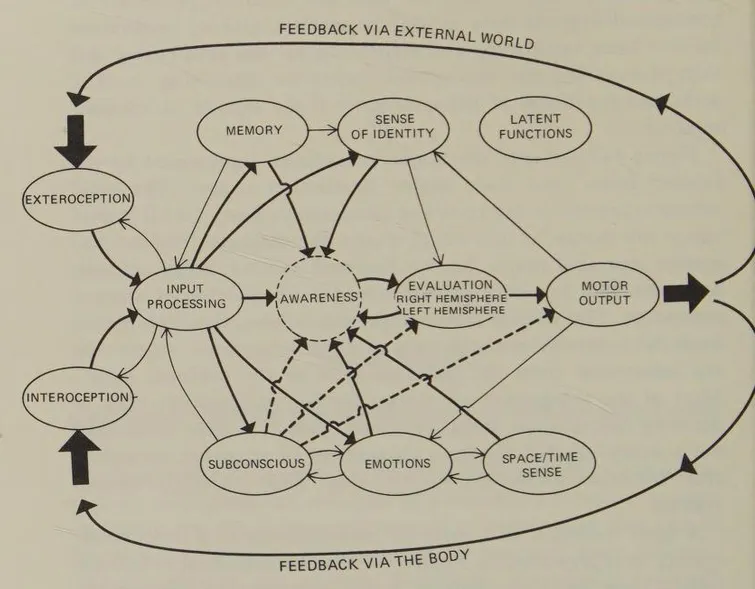
Before you waste your time on this chapter - know the picture is better than the product, in this case.
- These subsystems are conceptual, not physical systems. They assert this is a scientific process - and these are things that need to be investigated. (FWIW, the first edition of this book was published in 1975. The cognitive revolution just happened, and neuroscience was still hot garbo. )
- The figure outlines Tart’s view of major flow routes.
- Solid - major route
- Hatched - major feedback control routes
- Dashed - flow routes from the subconscious™️, they feel inferential
- A brief overview of the system…
- We get information from exteroception and interoception into input processing.
- Input Processing does filtering, selecting, and abstracting
- Input processing also influences our exteroception and interoception. (The predictive processing perspective has a more modern take on this.)
- Input processing grabs memories, stores memories, and pushes information into awareness and subconscious.
- It also “stimulates our Sense of Identity and our Emotions.” This is bidirectional.
- These components influence evaluation. An interesting note - this looks like how Tart theorized things could go directly from ‘the subconscious’ to evaluation and motor output - they can just skip awareness.
- Motor output feeds back into exteroception and interoception.
- Space/Time Sense also influence our emotions and awareness.
- They stick a free space in for ‘latent functions’ which are things generally not accessible in the current d-SoC.
- They are forthcoming in admitting this needs research.
Exteroception
- Your sense organs. They’re active, and you have some control over them. They argue subjective changes in sensory input are usually experienced in another subsystem - weed doesn’t make things smell better by adding receptors to your nose. (With the concession that, some drugs dilate our eyes.) Therefore, most experiences in intensity and clarity are affected by another system.
- Usually, you start trying to induce a d-ASC by messing with exteroception. Most the important changes happen within the Input Processing subsystem, but destabilizing the loading stabilization of exteroception / introducing noise may help.
- For an example - having someone close their eyes and doing some guided imagery. They do feel people could theoretically enter another d-ASC through fantasy immersion.
- Sensory deprivation is another example of this. (However, a lot of the sensory deprivation studies were contaminated by demand characteristics.) They argue weird sensory deprivation effects are almost always caused by expectations and context.
- They mention sensory input changes if you stare at a still image. I’m surprised they didn’t mention the troxler effect.
- Uh - rock concerts induce a d-ASC by overloading our receptors. :|
Interoception
-
… Yeah - I’ll just stick the link to Wikipedia for most of this.
-
Update from 1975 - interoception and awareness / conscious thought are bidirectional - they effect each other.
-
You can self-regulate interoception. (EG, shifting, relaxing, breathing exercises.) They mention biofeedback as “electronic yoga.”
-
They state there’s little feedback that things change at the level of “interoceptors” when changing d-ASC - so we’re sensing correctly.
-
They suggest interoception happens inside the concept of body image. The perception of your body is learned. It doesn’t always match an external observer.
-
Phantom limb phenomena happens. (So… are you trying to argue that interoception is usually accurate or this is happening at another level?) They say that social pressure can influence this perception.
-
They say the main thing is that body image can be rigid and may not map to what is actually going on in the body.
-
Experientially - people can report large changes in interoception in another d-ASC. (EG, changing the body’s shape and size. My counterargument is that I don’t think you need to get out of b-ASC to change this.)
-
Immobilization helps fade out or body the body’s interoception. (Relaxation.)
-
Massages and torture (overload) can introduce d-ASCs? (Kinksters here might be interested in this?… Hell, I’d go for just a chill, normal ass massage right now.)
-
“Unusual input” can change this.
Mudras, gestures of symbolic significance used in yoga, consist of putting the body into certain positions.
Tart, C. T. (2000). States of Consciousness. iUniverse.com, Inc. (Original work published 1983, Dutton)
Couldn’t more of this come from context and expectation?
- What in the fuck is an ASCID?… They suggest creating weird inputs can create altered states.
Since he is not used to such an anomalous, conflicting pattern of stimulation, it can greatly disrupt Input Processing.
Tart, C. T. (2000). States of Consciousness. iUniverse.com, Inc. (Original work published 1983, Dutton)
… This could also just be “do weird shit in expectant social contexts.” Fuggit. It could be fun.
Input Processing
-
Their thoughts on input processing generally rhyme with predictive processing. Or for an easier read, The Experience Machine.
-
They suggest a precursor to ‘thinking’ is processing input automatically.
-
Older people become more rigid in their processes.
-
Sure, priors matter. The psychoanalytic take is trash.
-
They suggest input processing is or abstraction.
-
d-ASC’s change input processing. They suggest ‘new modes of processing’ are possible. And yeah, drugs will fuck you up. And yeah, sometimes we misinterpret our inputs. Or “hallucinate” them as predictive processing likes to wank on about.
-
They separate memory from input processing, conflating priors and masked priors.
-
Bro if you’re hallucinating “my head has become soft” - consensus consciousness is indeed more accurate unless you died. Your argument is weak.
-
Okay sure maybe some people really do process negative hallucinations. Predictive processing explains this whole section a hell of a lot better - even if the model needs some love and I need to go skill up on global workspace theory. The take on ‘getting more raw sensory data’ I think is flawed.
-
Look - if you take hallucinogenic drugs, it’s not the d-ASC doing the work, it’s the fucking drugs messing with your receptors.
-
I’m going to start skimming this and see if I can grab the useful bits…
-
Wait. We’re talking about Castenada here? Ah fuck fall this. Okay sure you can scare the shit out of your subject. You might get negative valence, higher arousal, and shat pants but I don’t think you’re going induce a new d-ASC.
-
Dude you’re not coming in or out of a d-ASC just because you can focus your attention and take a minute to more accurately interpret your stimuli.
Memory
- … I’m going to trust Wikipedia’s article on Memory over this.
- They say memory can be associated with a d-SoC. This might have something to do with spontaneous amnesia in hypnosis, but I think it’s more attributable to association and context.
- They mention early studies on state dependent memory and alcohol. Research seems to have held up over the years, but I’m not an expert in this. In addition, I feel like they’re conflating d-SoCs and the condition of being blitzed.
- I don’t think the perspective of - you may remember things that happened during hypnosis while ‘feeling hypnotized’ - is too out there. I can’t remember some of my passwords unless I’m sitting right in front of my computer and have a keyboard under my hands. This could easily be misattribution, but useful in recreation.
- Yeah yeah spirit possession amnesia…
- Sure, we have associations, priors, masked priors, context… In addition active cognition and metacognition aren’t quite the same thing as ‘memory.’
Huh. THIS is novel and compelling. Deja vu for fun and recreation.
This extra informational quality of memory can sometimes be detached from Memory operation per se. It is possible to have a fantasy, for example, with the “this is a memory” quality attached, in which you mistakenly believe you are remembering something instead of just fantasizing it. Or, the quality may be attached in a d-ASC to an incoming sensory perception, triggering the experience of ddja vu, the feeling that you have seen this before. Thus you may be touring in a city you have never visited and it all looks very familiar; you are convinced you remember what it is like because of the presence of the “this is a memory” quality.
Tart, C. T. (2000). States of Consciousness. iUniverse.com, Inc. (Original work published 1983, Dutton)
Their footnote is much less compelling…
Note that while this is probably the cause of most Mjd. vu experiences, some kinds of dejct vu may actually represent paranormal experience.
Tart, C. T. (2000). States of Consciousness. iUniverse.com, Inc. (Original work published 1983, Dutton)
- They separate out the feelings of ‘this is a perception’ and ‘this is a memory.’
- In their fanfiction the Sense of Identity occurs mostly in memory.
- For fuck’s sake don’t use hypnosis to try to recall buried information. This has been fucking us over for decades.
Subconscious
Oh boy. Time to go full whiteboard psychoanalyst misattribution masturbation mode.
- Oh man, I guess this is where a lot of the bullshit of ‘the subconscious can access inaccessible memories’ came from. If you suggest repressed memories as an expectation, you’re going to end up creating that deja vu mechanism you just mentioned, and you’re going to create false memories. Fuck this whole section.
- There’s no advice on creating d-ASCs here, so I don’t feel bad for skipping it, as I not only feel the information here is wrong, it’s flat out harmful. Personal perspective - if someone’s currently suggestible, be careful, you can fuck things up.
Evaluation and Decision Making
- Yeah - a lot of our rationalization and explanation happens in post. Personal take - we see this in tricks that Amir Raz would describe. Make some make a liked and disliked pile of face cards. Swap them - ask them why they liked their dislike deck without them knowing. You’ll likely get a confabulated answer.
- Turning your thinking/evaluation off is really hard.
- Oh my god you’re wrong about pot - THC stimulates receptors associated with novelty, so when you figure something out, it feels way more novel.
- Without getting into their sauce - sure, you can give people some illogical novelty during hypnosis.
- In a d-ASC - we may be more tolerant of logical errors or incongruities. I think there might be something to this. However, I think it has more to do with not worrying about the amount of bullshit you’re being subjected to in order to experience something novel than a system level pattern modification. Of course thinking “this is stupid” or “this is wrong” is going to knock you out of a hypnotic experience.
- Suggesting ‘not giving a shit about logic’ might be useful.
- Fuck this hemisphere kayfabe. Research on creating left and right rain splits is imaginative at best. If you go looking for evidence of neuroscience with anything but a brain scanner, you’re kinda hosed. If you use fMRIs and EEGs, you’re still kinda hosed.
- Man I don’t think that “just say the first thing that comes to mind” is evidence of a d-ASC.

All right. I’m going to skim and look for advice on creating alterations.
Emotions
- Oprah: “That’s a d-ASC! That’s a d-ASC! Every little alteration is a d-ASC!”
- Oh my god screw Don Juan and Castaneda.
Space / Time Sense
- A novel experience - not just time dilation, or constriction, but seeing into the future then it happens. (Likely misattribution, but neat.)
- Feeling present in the moment.
- “Archetypal time” - stoner time, when everything feels right.
- Timelessness - events simply “are” and do not happen at a specific moment. Something feels super long.
Sense of Identity
- Social context of an individual.
- Social context of yourself. Or - self identity.
- Bla bla ego bla.
- Dude get to the fucking point.
- Yup you can fuck with this via suggestion. Sometimes you break things and you should probably go easy on the sauce.
- Bruh. If you can argue berserkers are in a d-ASC, then Karens can also be in a d-ASC and you should avoid them, because they certainly act like they are on drugs. This is more comedy than worth serious consideration.
Motor Output
- FUCKING CARLOS CASTANEDA AGAIN?!
- Yup you sure can suggest lightness or heaviness in an arm, and it may feel avolitional.
This ends our survey of the main subsystems of states of consciousness.
Tart, C. T. (2000). States of Consciousness. iUniverse.com, Inc. (Original work published 1983, Dutton)
Thank fuck.
Ch9 - Individual Differences
Section titled “Ch9 - Individual Differences”I was going to read this - but the author kind of nuked his credibility in the last chapter.
Ch14 - The Depth Dimension of a State of Consciousness
Section titled “Ch14 - The Depth Dimension of a State of Consciousness”… I don’t think it’s worth taking direct notes of this chapter.
- Recreational tip: make your own depth scale up. You can create expectation this way - both in creating experience and incremental improvement.
- Things you might be able to suggest - it may be worth considering the problem of “don’t think of the pink elephant” in your suggestions:
- Timelessness. Time being a meaningless concept.
- Your voice - being focused on, being distant, being remote, just a voice, or going full wank with “Just an amusing, tiny ripple at far fringes of an infinite sea of consciousness.” The fuck does that mean?
- Vision becoming blackness, then losing awareness of it. (Oh my fucking god tart he saw hypnagogic phosphenes. PHOSPHENES. )
- Lack of awareness of the environment.
- Rate of time passage
- Less evaluative thinking