Patrick Haggard - 1 - Human Volition
Talk at… https://youtu.be/NXgInKiZ8jY?list=PLplZlMKmYMNEpkXmMLm_cUcEgty3FrxJe&t=1
Part 1 on a series of lectures on volition, agency, and responsibility.
Introduction
Section titled “Introduction”https://youtu.be/NXgInKiZ8jY?list=PLplZlMKmYMNEpkXmMLm_cUcEgty3FrxJe&t=62
Volition - processes underlying the motivation, choice, and initiation of one’s actions.
https://youtu.be/NXgInKiZ8jY?list=PLplZlMKmYMNEpkXmMLm_cUcEgty3FrxJe&t=251
- There’s an objective certainty of action
- There’s an elusive phenomenology
- Some voluntary actions are very important.
1 - Internally-generated action
Section titled “1 - Internally-generated action”https://youtu.be/NXgInKiZ8jY?list=PLplZlMKmYMNEpkXmMLm_cUcEgty3FrxJe&t=364
“What is left over if I subtract the fact that my arm goes up from the fact that I raise my arm?” - Ludwig Wittgenstein, Philosophical Investigations, S621 (pfft, nice)
They’ll be reverse engineering the fact that the arm moved. Muscles move in the person’s right arm. Muscles on the right hand side of the body are controlled by the primary motor cortex in the left hemisphere. In front of the primary cortex is “Broadman’s area 6.” In the lateral part of area 6 there are neurons that communicate to the primary motor cortex (often in response to other stimuli - like catching a ball.) The medial part (supplementary motor area) seems to be for ‘internally generated actions.’
https://youtu.be/NXgInKiZ8jY?list=PLplZlMKmYMNEpkXmMLm_cUcEgty3FrxJe&t=570
There is a contrast between internally generated vs externally generated movement in cognitive neuroscience. EG - is it “free will” or a “reflex.” Cognitive neuroscience often defines some actions as “not caused by an external stimuli.”
https://youtu.be/NXgInKiZ8jY?list=PLplZlMKmYMNEpkXmMLm_cUcEgty3FrxJe&t=692
Seen as a process, this could be seen as…
Externally generated actions:
- Stimulus => Response
Internally generated actions:
- Nothing => Movement
- “I” => Movement
- Consciousness => Movement
These arguments are exceptionalist.
https://youtu.be/NXgInKiZ8jY?list=PLplZlMKmYMNEpkXmMLm_cUcEgty3FrxJe&t=766
Instead of volitional actions coming from ‘nothing,’ you could see them as coming from ‘everything.’
- Everything => cognition [Intelligence? Rationality? Reward-based decision making?] => movement
Haggard asks us to remember that voluntary action is focusing on the movement. It’s focusing on thoughts that turn into physical events. Volitional action is interesting because of the effects it can have on our environment and on other people.
https://youtu.be/NXgInKiZ8jY?list=PLplZlMKmYMNEpkXmMLm_cUcEgty3FrxJe&t=922
There may be more to the idea of internally generated action. We can split up context into components.
- [Context - Memory - Needs - Exploring] => Cognition => Movement
- They’re all…
- Biologically comprehensible
- Covert, socially opaque
- Regulatory control
- Motoric/behavioral target
- They’re all…
2 - Relation to subjective experience
Section titled “2 - Relation to subjective experience”https://youtu.be/NXgInKiZ8jY?list=PLplZlMKmYMNEpkXmMLm_cUcEgty3FrxJe&t=1099
Why is there an experience of volition? The phenomenology of the subjective experience…
https://youtu.be/NXgInKiZ8jY?list=PLplZlMKmYMNEpkXmMLm_cUcEgty3FrxJe&t=1140
There’s a history of measuring conscious experience implicitly through mental chronometry.
- Hermann von Helmholtz (1821) - observed that mental processes took measurable time. When an experience occurs can give us insight into the process.
- Wilhelm Wundt (1832-1920) - developed methodological tools for measuring mental chronometry.
- Benjamin Libet (1916-2007) - took the methods of Wundt and turned them into actionable experiments.
https://youtu.be/NXgInKiZ8jY?list=PLplZlMKmYMNEpkXmMLm_cUcEgty3FrxJe&t=1299
The Libet experiment (Libet et al. 1983) is to measure the time it took for volition to change into action. (EG - measuring the time between when you decided to push a button, to the time that you actually pushed the button.) When did you “feel the urge” to move.
https://youtu.be/NXgInKiZ8jY?list=PLplZlMKmYMNEpkXmMLm_cUcEgty3FrxJe&t=1522
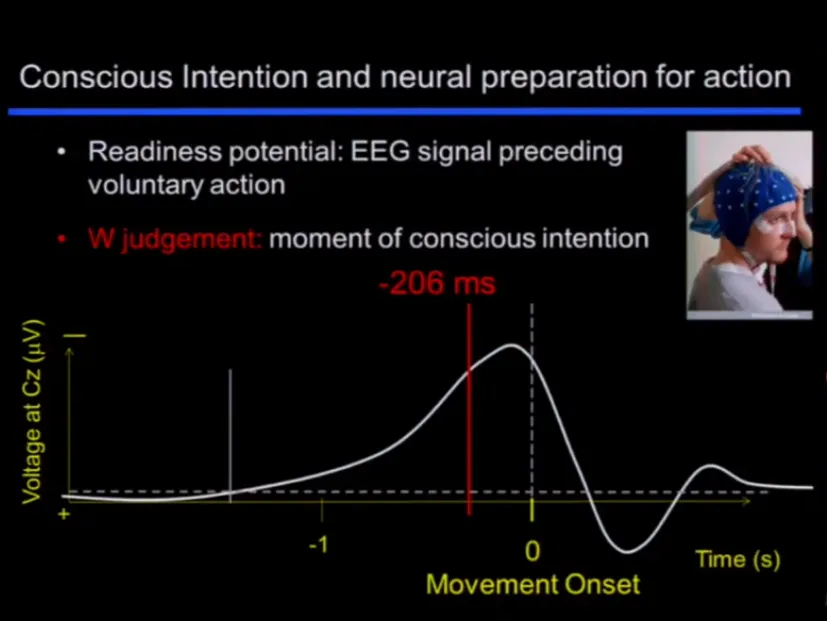
While this was happening - Libet was also recording on an EEG. The readiness potential (from Libet’s view) was a signal preceding voluntary action. The W (will) judgement is the moment of conscious intention. Preparation appears to happen before you were aware of the intention.
https://youtu.be/NXgInKiZ8jY?list=PLplZlMKmYMNEpkXmMLm_cUcEgty3FrxJe&t=1696
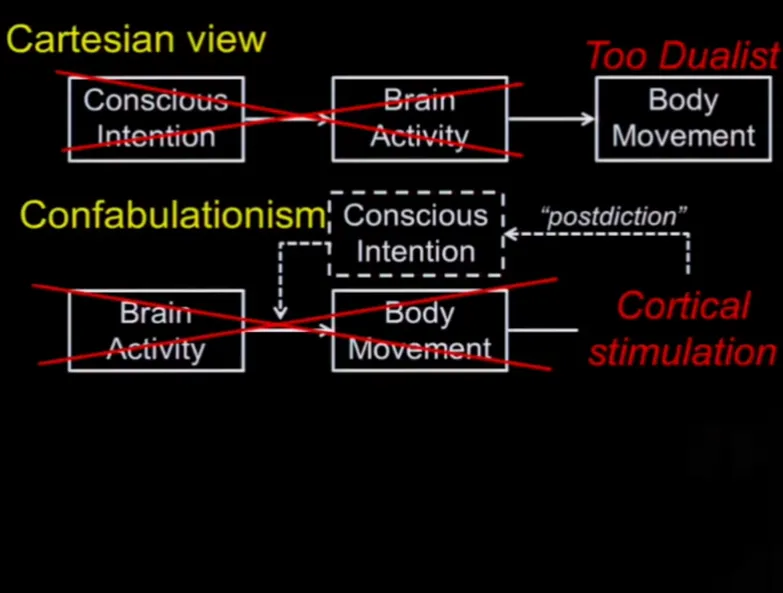
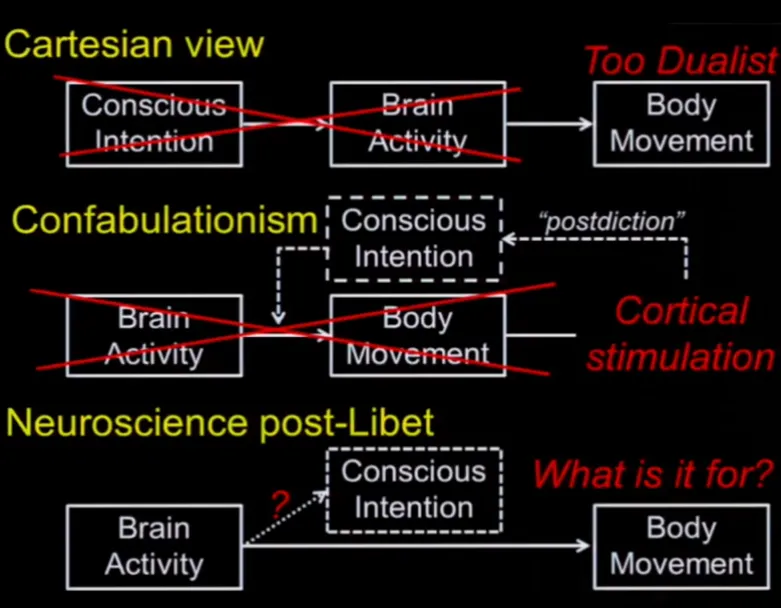
Cartesian view volition:
- Conscious intention => Brain Activity => Body Movement
- This must be incorrect - it’s too dualist. You’re the brain activity, you’re not removed from it.
Confabulationism:
- We ‘inject’ feelings of volition back into the brain, based on sensory feedback. This certainly happens sometimes. Patrick Haggard suggests this only happens sometimes, specifically in cases of direct cortical stimulation.
https://youtu.be/NXgInKiZ8jY?list=PLplZlMKmYMNEpkXmMLm_cUcEgty3FrxJe&t=1860
Uh - in folks with intractable epilepsy - Fried (1991) will stimulate areas in the brain to make sure he doesn’t chop out the wrong part. People will say they have an “urge” to move their right arm. It’s conscious, but not actual movement. Interestingly, at higher levels, they actually moved the arm. (This might correlate with the EEG readouts from the Libet experiment.) Patrick Haggard highlights that this isn’t the only area that you can get movement urges from (eg - the parietal cortex.)
https://youtu.be/NXgInKiZ8jY?list=PLplZlMKmYMNEpkXmMLm_cUcEgty3FrxJe&t=2083
Awareness of conscious intentions are a consequence of, not the cause of movement.
https://youtu.be/NXgInKiZ8jY?list=PLplZlMKmYMNEpkXmMLm_cUcEgty3FrxJe&t=2120
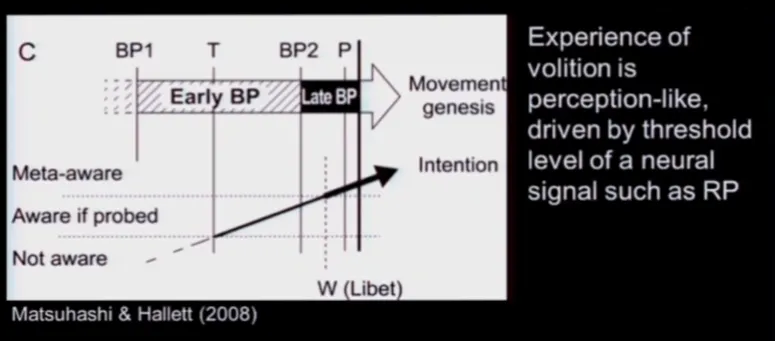
What gives us the feeling of intention? There may be thresholds that you may be aware of if asked, and thresholds you’re always aware of, even if not asked.
https://youtu.be/NXgInKiZ8jY?list=PLplZlMKmYMNEpkXmMLm_cUcEgty3FrxJe&t=2212
There’s some philosophical critique of Libet.
- There’s temporal precedence of brain before mind
- Mental chronometry is better at relative time than absolute time
- Therefore - timing is just a clue “about the content of experience.”
https://youtu.be/NXgInKiZ8jY?list=PLplZlMKmYMNEpkXmMLm_cUcEgty3FrxJe&t=2311
Haggard brings out some of his own cool research.
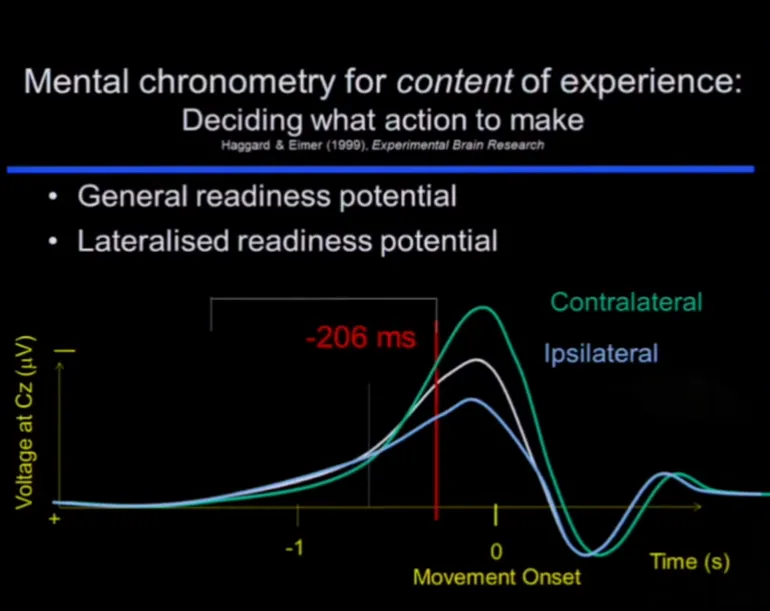
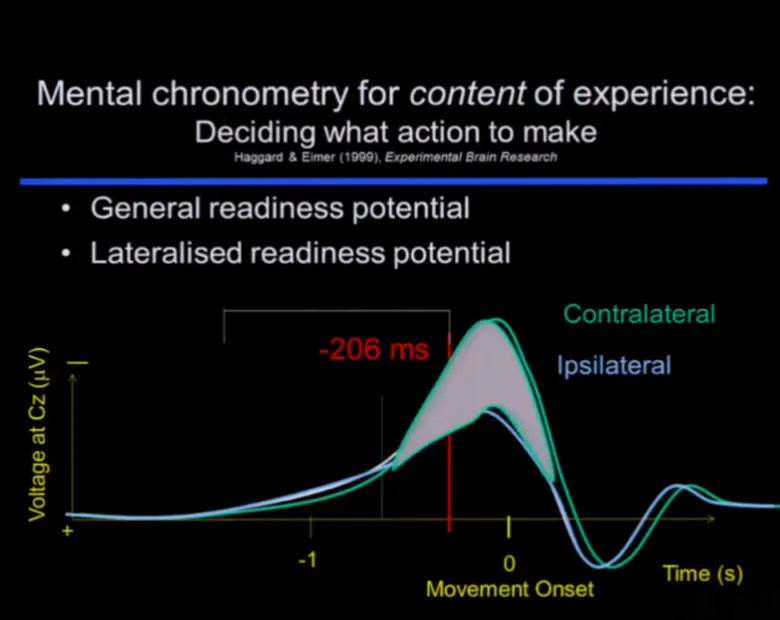
- The lateralized readiness potential occurs about half a second before the actual movement. (It’s contralateral, opposite side.)
- The difference between the contralateral hemisphere and ipsilateral hemisphere (as illustrated by the blob) indicates a shift towards the cortex that’s actually going to move the hand
https://youtu.be/NXgInKiZ8jY?list=PLplZlMKmYMNEpkXmMLm_cUcEgty3FrxJe&t=2418
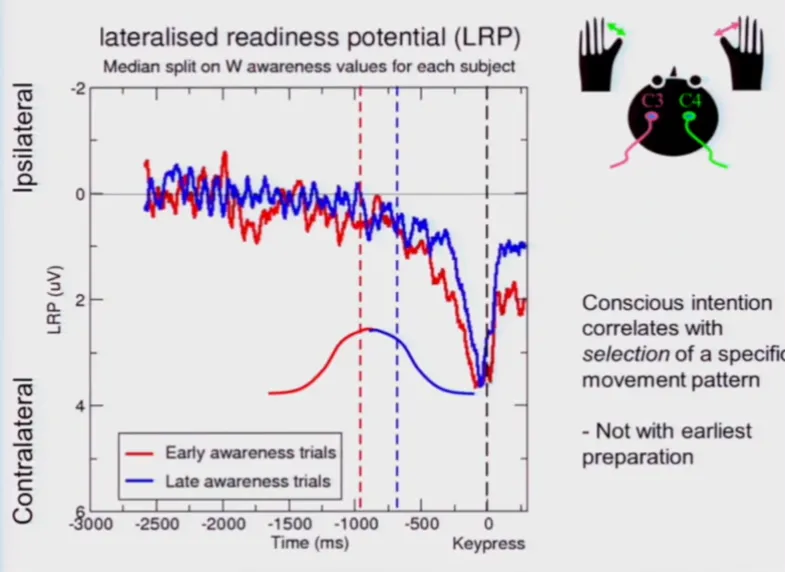
More research - this time, it’s twice as exciting! You can see a contralateral shift late awareness potentials. This might be about deciding the specific intention of pushing the button, not about sitting down and doing the boring experiment.
https://youtu.be/NXgInKiZ8jY?list=PLplZlMKmYMNEpkXmMLm_cUcEgty3FrxJe&t=2621
But of course, there’s critique of the readiness potential.
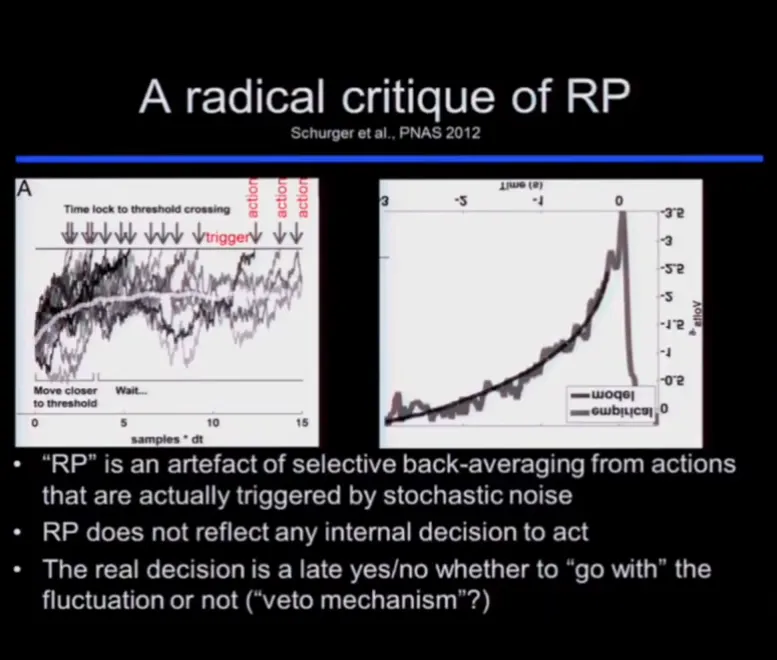
Schurger et al., PNAS 2012
- Maybe some part of our actions is just noise. The ‘threshold’ for action could just be ‘random.’
- If you average all the brain activity moving towards the readiness potential, it just looks like noise. This may have nothing to do with conscious intention.
https://youtu.be/NXgInKiZ8jY?list=PLplZlMKmYMNEpkXmMLm_cUcEgty3FrxJe&t=2878
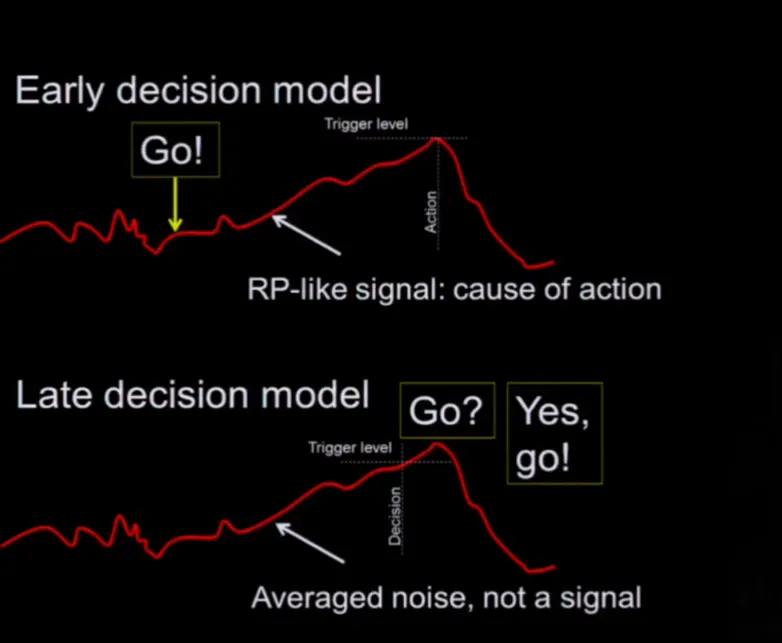
There are two broad classes of volitional mechanisms:
- Early decision models - “go” is followed by “yup doing it.”
- Late decision model - “Go? Yes, go!” (The RP is just noise, not determinant of behavior.)
3 - Search for internal volitional signal
Section titled “3 - Search for internal volitional signal”https://youtu.be/NXgInKiZ8jY?list=PLplZlMKmYMNEpkXmMLm_cUcEgty3FrxJe&t=2975
Well - we need to make sure that the research is worth our time (ecologically valid.) What would the constraints be?
- Instructions may guide people towards an urge. Research needs to remove the ‘reason’ for doing something. The reasons need to be more than just a stimulus. (They need a non-stimulus driven action, instead, driven by ‘reason.’)
https://youtu.be/NXgInKiZ8jY?list=PLplZlMKmYMNEpkXmMLm_cUcEgty3FrxJe&t=3210
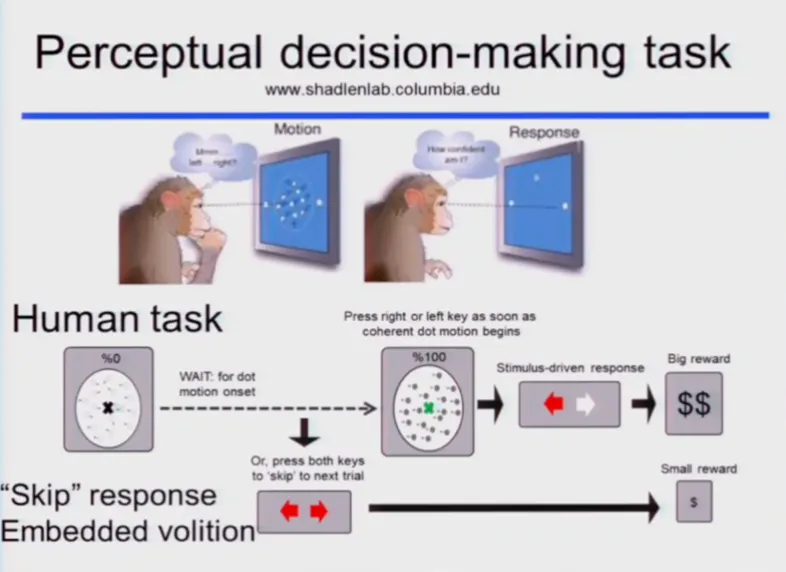
They’ll have the human push the left or right button depending on the direction the dots converge. (Uh, but for humans, they make it very boring. ) You can either wait or use a “skip response” by pushing both buttons at the same time.
Here’s why this is a big deal. The skip response isn’t caused by a stimulus, but internally by the participant’s impatience.
https://youtu.be/NXgInKiZ8jY?list=PLplZlMKmYMNEpkXmMLm_cUcEgty3FrxJe&t=3409
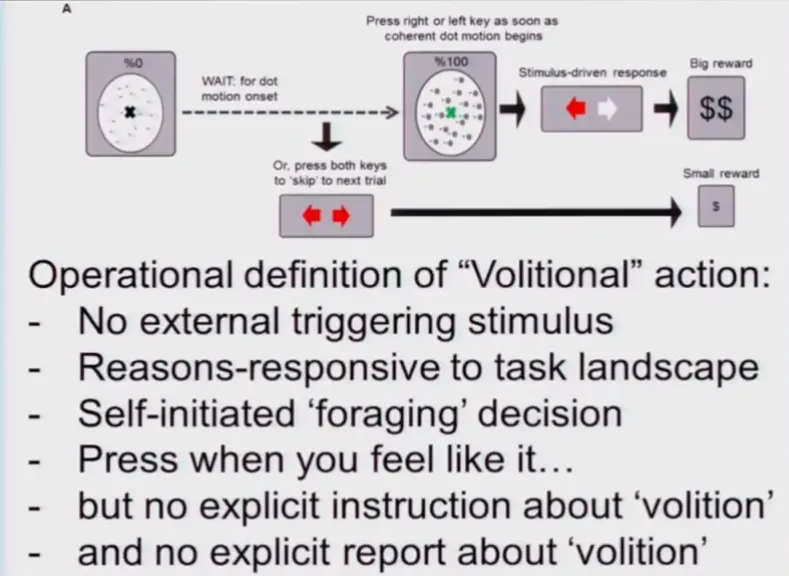
Critically - in this case, they never had to tell the participant when to push the button.
https://youtu.be/NXgInKiZ8jY?list=PLplZlMKmYMNEpkXmMLm_cUcEgty3FrxJe&t=3494
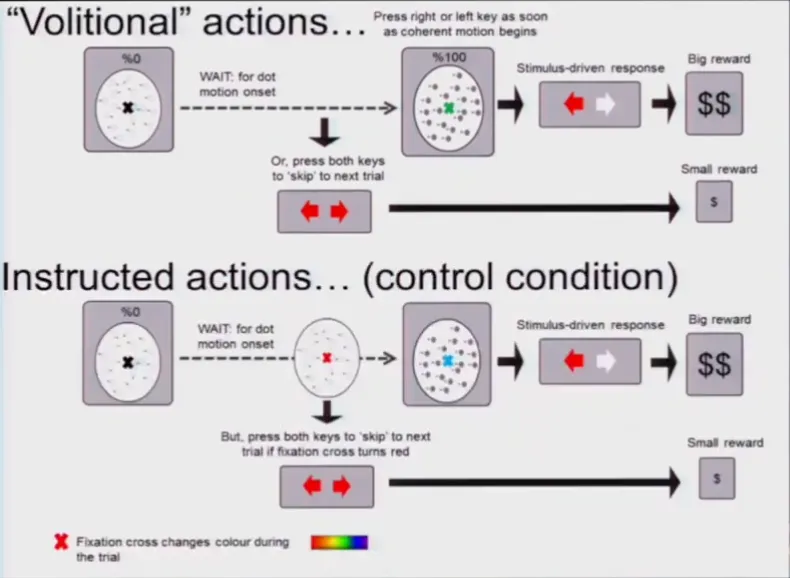
The control condition is that the dot will change to red, and you’re supposed to hit both at the same time. This is stimulus driven. So now they can tease out volitional actions.
https://youtu.be/NXgInKiZ8jY?list=PLplZlMKmYMNEpkXmMLm_cUcEgty3FrxJe&t=3531
Now they can separately measure these signals. Self initiated skips are smoother than the externally generated one. Averaged trials (the second image) show a convergence.
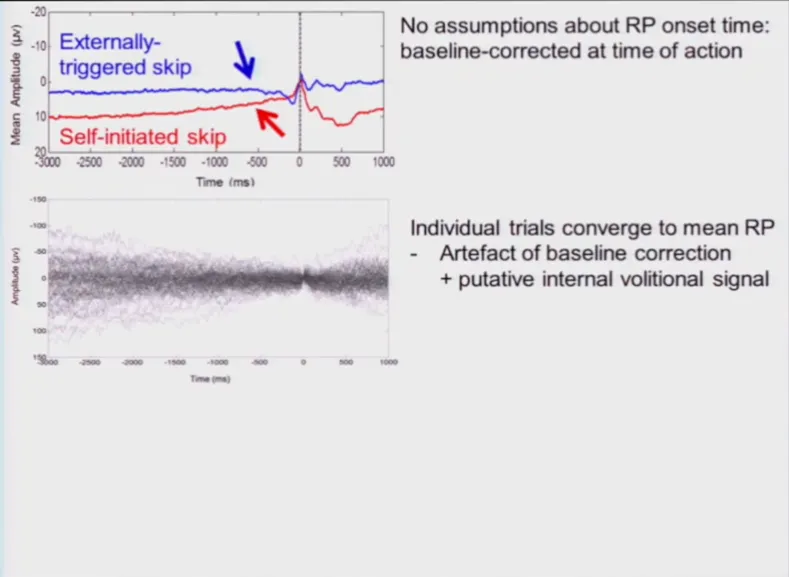
https://youtu.be/NXgInKiZ8jY?list=PLplZlMKmYMNEpkXmMLm_cUcEgty3FrxJe&t=3711
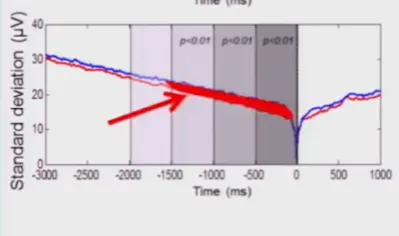
The standard deviation is more marked in the self-initiated skip response.
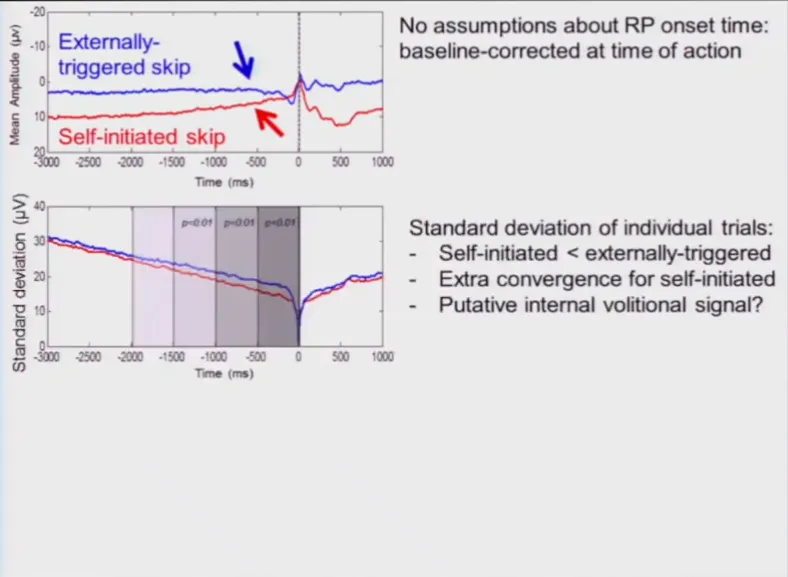
The difference highlighted between self-initiated and externally triggered…
https://youtu.be/NXgInKiZ8jY?list=PLplZlMKmYMNEpkXmMLm_cUcEgty3FrxJe&t=3770
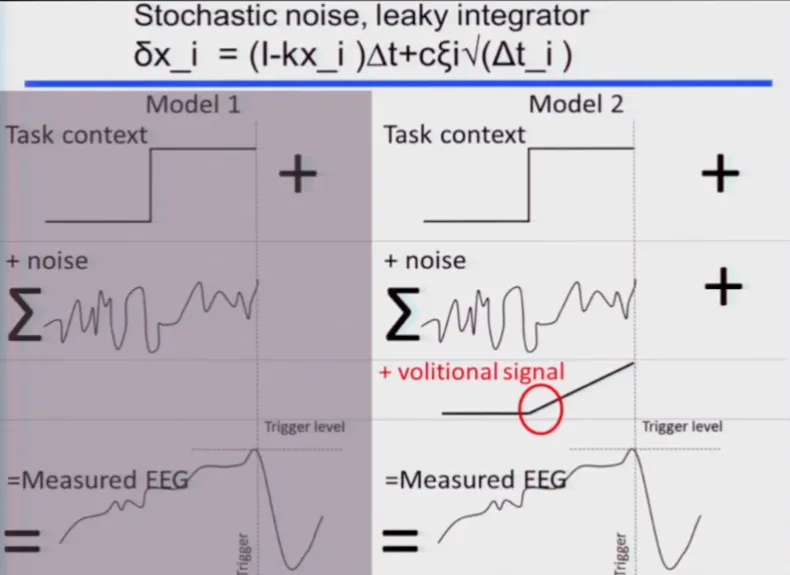
But - can it be modeled?
They added noise to a stochastic noise to see if it’d produce an accurate model. 🤷
https://youtu.be/NXgInKiZ8jY?list=PLplZlMKmYMNEpkXmMLm_cUcEgty3FrxJe&t=3832
They fit the data to the mean readiness potential, then tested on the standard deviation.
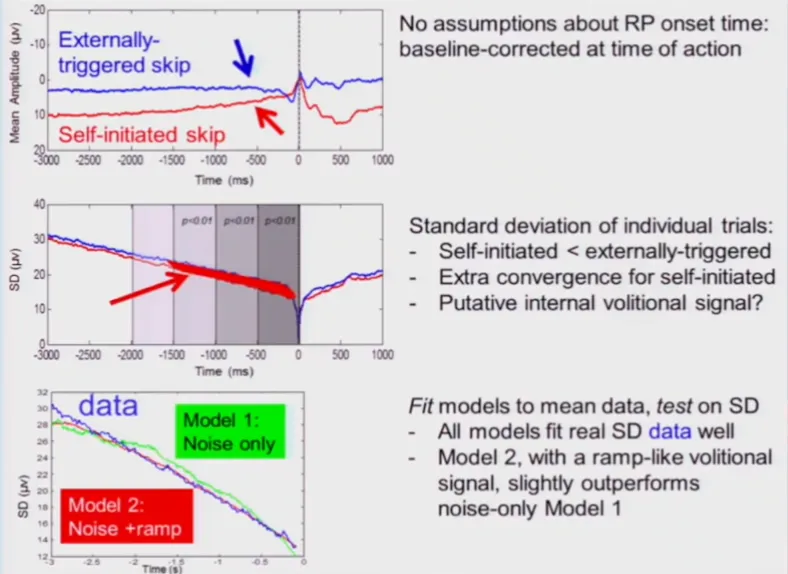
The model 2 looks like it fits pretty well! Model 2 included special sauce ramp.
https://youtu.be/NXgInKiZ8jY?list=PLplZlMKmYMNEpkXmMLm_cUcEgty3FrxJe&t=3900
So - there’s definitely a lot of noise in these signals. However, there is another signal buried deep in there.
Conclusions
Section titled “Conclusions”- Free will can be volitional - not exceptionalist
- Experiment design matters
- Internally generated actions must have precursors
- It could be from the integration of cognitive processes
- There could also be homeostatic loops as part of a larger structure
- Volition isn’t just a confabulation, and can be studied. Confabulations do happen, but they are not the norm.